
| Topic | What the evidence shows | Planning use |
|---|---|---|
| Named inventor | No documented inventor; no one knows who made the first cheese | Credit early dairy farming, not a person, in any summary or caption. |
| Oldest cheese-making evidence | Milk residues on 34 perforated pottery vessels from Poland, about 7,500 years old | Use as the benchmark when a claim says “oldest cheese-making”. |
| Earlier milk residues | Near East pottery residues about 8,000 years old that did not clearly show milk processing | Cite as evidence of dairy use, not of cheese. |
| Ancient records | Cheese making dates back more than 4,000 years | Use when a claim rests on documents or images rather than residue. |
| First U.S. cheese factory | Built by Jesse Williams in Oneida County, New York, in 1851 | Anchor the American factory-cheese timeline here. |
Figures come from the International Dairy Foods Association’s history of cheese and a report on the Polish pottery findings published in Nature.
Nobody is known to have invented cheese, so who invented cheese has no named answer. The oldest reported cheese-making evidence is about 7,500 years old, found on pottery in Poland, and it points to early dairy farming rather than one inventor.
Cheese is one of several foods with a contested origin in the history of candy and food origins collection, where each guide separates documented evidence from legend.
Why there is no inventor to credit
The IDFA states plainly that no one really knows who made the first cheese. The NHCC museum goes further and says the actual time and place of the origin of cheese and cheesemaking are unknown. IDFA still gives a floor, since ancient records show that cheese making dates back more than 4,000 years.
That has practical consequences for anyone writing, teaching or captioning a cheese story.
- Credit a practice, not a person. A page that names one inventor claims more than either organisation does, so describe cheese as the product of early dairy keeping.
- Match the claim to its evidence type. A tomb mural, a pottery residue and a preserved lump of cheese answer different questions, and mixing them produces false precision.
- Keep “oldest” categories apart. Archaeological residue, ancient preserved cheese and the oldest edible cheese are separate records, covered next.
The oldest cheese ever found
The answer depends on what counts. Residue on pottery, a preserved ancient cheese and a cheese still safe to eat each hold a different record.
Pottery residues in Poland
The oldest reported cheese-making evidence is chemical. According to a report on the findings, milk extracts were identified on 34 perforated pottery vessels excavated in Poland, dated to about 7,500 years ago, and the results were published in the journal Nature. Earlier milk residues exist on Near East pottery dating back 8,000 years, but those did not clearly show milk processing. That distinction is why the Polish vessels are treated as the earliest evidence of cheese making rather than just of milk use.
The Taklamakan Desert cheese
A cheese from the Taklamakan Desert in Xinjiang is about 3,600 years old, according to a cheese history summary. It lacked animal enzymes such as rennet, so it is a useful reminder that early cheese did not have to follow the later rennet method.
Egyptian tomb evidence
Ancient Egypt supplies the best-known images and objects. The NHCC museum cites cheese and cheesemaking evidence on Egyptian tomb murals dating back over 4,000 years. Separately, Egyptologists found a whitish solid mass of cheese in a tomb, dated to the 13th century BCE and made from sheep and goat milk, as the same cheese history describes. Use the murals for the age of the practice and the tomb cheese for the material itself.
The oldest edible cheese
If the question is about cheese you could actually eat, the record is far younger. A cheddar produced in Oconto, Wisconsin, aged about 40 years and found in 2012, was reported as the oldest edible cheese in the world. It is an aging record, not an origin record, so never set it beside the pottery or tomb finds as if they competed.
Parmesan and the other “new” classics
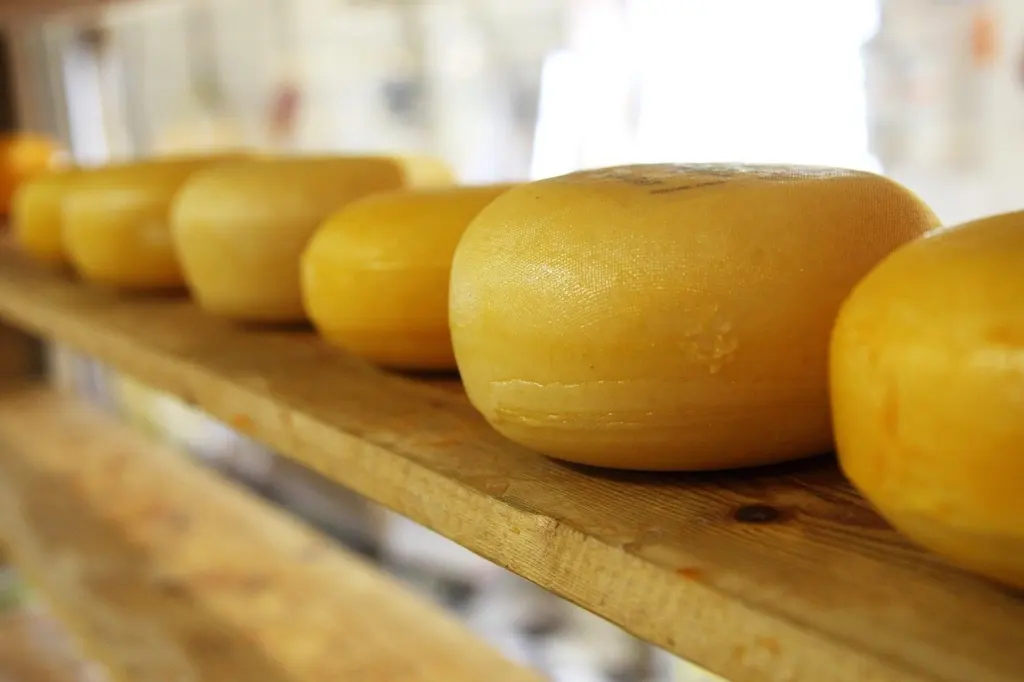
Parmesan (Parmigiano-Reggiano) belongs to the late chapter of cheese history. The NHCC museum notes that many popular cheeses, including Cheddar, Swiss, Parmesan and Gouda, are relatively new and appeared within the last 500 years. Next to a 7,500-year-old pottery residue, that makes Parmesan a recent refinement of an ancient craft.
The same dating applies to Cheddar. Its modern fame sits alongside the Oconto cheddar record above, while its origin sits within that 500-year window and not in antiquity.
When a label, menu or story pushes Parmesan, Cheddar or Gouda back to ancient times, the museum’s dating is the check to apply. The practical rule is to attribute them to a recent tradition, and to keep Neolithic and Egyptian examples for cheese in general.
American cheese from farm to factory
Early production and the first factories
American cheese making is far younger than the Old World finds. The NHCC museum says cheese has been produced in America since early in the 17th century, brought by English Puritan dairy farmers. It dates Wisconsin’s first farmstead cheese factory, in Koshkonong, to 1831.
The IDFA gives a different milestone, stating that the first cheese factory in the United States was built by Jesse Williams in Oneida County, New York, in 1851.
Natural cheese and processed cheese at scale
IDFA reports that total natural cheese production grew from 418 million pounds in 1920 to 2.2 billion pounds by 1970. Processed cheese then had its own surge in demand, with annual production exceeding 2 billion pounds by the early 1990s. IDFA tracks the two categories separately.
The comparison is useful because the two origin stories are different in kind. Natural cheese traces back through pottery, murals and tombs, while processed cheese is a factory-era category measured in production totals. Anyone explaining “American cheese” should say which of the two they mean before giving a date.
How early people arrived at cheese making
Cheese making could not begin before milking did. The report on the Polish vessels notes that only domesticated animals can be milked, so the origins of cheese making are unlikely to predate the Neolithic. The same report links the practice to a practical benefit, since processing milk into cheese reduces its lactose content, which mattered for largely lactose-intolerant Neolithic people.
Rennet is the best-known tool in the process. The NHCC museum describes it as an enzyme found in the stomach of ruminant animals that causes milk to coagulate. Coagulation separates the milk into curds and whey, and the curds are what become cheese.
The popular tale that rennet was discovered by accident is an appealing explanation, but no excavated find documents the moment of discovery. The rennet-free Taklamakan cheese also shows that animal enzymes were not the only route. Read the rennet story as an account of how cheese forms, not as a recorded event.
Frequently asked questions
Was the Egyptian tomb cheese safe or clean?
No. The solid mass of cheese from Saqqara showed traces of brucellosis bacteria, according to the cheese history summary.
Which animals’ milk do Cheddar and Gouda come from?
They are described as cow milk cheeses that offer balance and familiarity, in contrast to the sheep and goat milk used in the Egyptian tomb cheese, per a cheesemonger’s history.
Where did Wisconsin’s first farmstead cheese factory open?
It opened in Koshkonong, according to the NHCC museum.
Who opened the first cheese factory in Green County, Wisconsin?
Nicholas Gerber opened it in 1868, per the NHCC museum.