Why is it called jaywalking? In early 20th-century slang, a jay was a rube or country person, so a jaywalker was a pedestrian mocked for crossing streets wrongly. Car-era campaigns then turned the insult into a legal offense.
The word is a good example of slang hardening into law, and it sits comfortably among other origin of common phrases stories. The path runs from a rural put-down, to a newspaper cartoon, to a city ordinance, to a nationwide habit of speech.
The slang meaning of jay
A jay was an insult long before it described a rule. KCUR’s account of Kansas City’s jaywalking history reports that jay was a pejorative term typically aimed at rural people, and that in early 20th-century parlance it meant “idiot.” Drive Safe Online gives a closely related sense, noting that “jay” was a derogatory term meaning “novice” or “rube.”
These definitions overlap rather than conflict. Each describes an unsophisticated outsider, and the cruder versions simply call that person stupid. That is the stock figure the word jaywalker borrowed. A jay walker was someone who moved through city streets in a way city people thought foolish.
The jay in jaywalking is therefore a human type, not an animal. That answers the slang question directly: the word belongs to the same family of insults as other labels for naive country visitors, and the sting depended on the city-versus-country divide of the period.
First appearance in print
The earliest known printed example in the evidence is a cartoon, not a dictionary entry. According to KCUR’s reporting on historian Peter Norton’s research, the first known illustration of a “jay walker” appeared in the Kansas City Star on April 30, 1911. It was printed as a split phrase, which shows the term had not yet settled into the single word we use today.
That illustration precedes the earliest Oxford English Dictionary citation for the word by six years. The gap is a useful caution for anyone checking word origins. A dictionary’s earliest citation records the oldest example the editors had found at that point. It does not prove when people first said the word, and newspaper research can push the date back.
From newspaper insult to Kansas City ordinance
Kansas City is where the insult became a rule. Boston and Minneapolis had earlier ordinances aimed at pedestrians, but according to KCUR’s account they did not use the term and none of them was ever really enforced. Kansas City’s measure was the first anti-jaywalking ordinance of its kind in the country.

| Date | Event | What it shows |
|---|---|---|
| April 30, 1911 | The Kansas City Star prints the first known “jay walker” illustration | The mocking label was already circulating in print |
| 1911 | Kansas City adopts the first anti-jaywalking ordinance of its kind, banning crossing outside crosswalks with a potential fine of $5 to $50 | The slang term became attached to an enforceable rule |
| January 25, 1912 | Samuel Hebel becomes the first person arrested for jaywalking in Kansas City | The rule was applied to a named individual, not left as a paper ordinance |
The dates and penalties above come from KCUR’s history of jaywalking in Kansas City.
The enforcement step matters most for the word’s history. Earlier ordinances sat unused and unnamed, while Kansas City paired a mocking name with real penalties. KCUR also describes Kansas City as the first city to make jaywalking a criminal offense, which is why the city features in nearly every origin story for the word.
How cars and motor clubs spread the term
The word spread because cars changed who owned the street. The mechanism ran in stages, and each one made the insult more useful to someone.
- Cars arrived slowly. KCUR notes that at first, cars were moving a mere 5 to 15 miles an hour. Pedestrians had long treated streets as shared space, so crossing anywhere was normal.
- Automobile clubs wanted drivers protected. The clubs represented drivers, insurers and dealers, and in the 1911-1912 Kansas City context they wanted drivers shielded from liability for injuring pedestrians. A rule placing the burden on walkers served that aim.
- The industry adopted the insult. As The Northern Light’s account of traffic safety history puts it, the automotive industry didn’t coin the word. It took an existing put-down and used it, a pattern that ran through the 1910s and 1920s.
- Newspapers carried the blame. The same account describes George Graham launching a centralized accident news service for newspaper reporters, tied to the National Automobile Chamber of Commerce. Newspapers were then reporting that 70 to 90 percent of car-versus-pedestrian crashes were caused by jaywalkers.
The stakes were real. KCUR reports that in the 1920s, motor vehicle crashes caused more than 200,000 deaths in the United States. In that climate, a label that put fault on pedestrians gave drivers and their industry a ready answer.
That is the unusual part of this word’s history. The insult did not need to be invented in the 1920s. The campaigns gave an older slang term its legal and social force, and a sneer about rural manners became a standard description of a traffic offense.
Is the word tied to the blue jay?
The documented explanations rest on the slang sense of jay, not on the bird. Nothing in the evidence connects the behavior of blue jays to the word, and the people who coined and promoted it were describing a type of person.

Two other guesses circulate. KCUR notes that the term doesn’t actually have anything to do with the jayhawk, the Kansas Civil War moniker that later became a mascot. The Kansas City setting makes that mix-up tempting, but the two share only a spelling.
The other guess is that the word began as “J-walking.” Drive Safe Online mentions that another view is that “jaywalking” was actually “J-walking,” and adds that no historical texts or folklore point to the origin of the word. Treat the letter theory as folk etymology. The slang meaning of jay and the dated 1911 cartoon are the documented trail.
What jaywalking means today
Modern dictionary-style definitions have dropped the insult and kept the behavior. Vocabulary.com says that to jaywalk is to cross the street in the middle of the block rather than at a crosswalk. Drive Safe Online widens that slightly, describing a pedestrian walking in or crossing a roadway at an unsuitable crossing point.
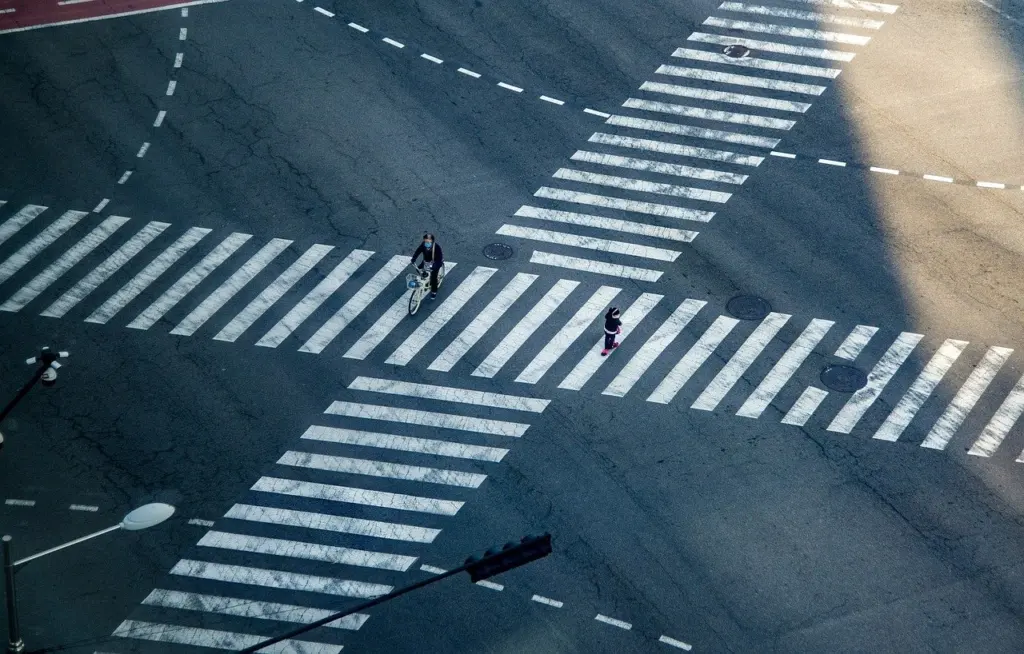
The legal picture is local. Drive Safe Online states that there is still no federal law against jaywalking, so states and cities write their own rules. The exact wording of an offense, and what counts as an unsuitable place to cross, depends on where you are.
For anyone checking a specific rule, look at the traffic code of the state or city in question rather than relying on the general definition above.
Using the word with its history in mind
Use jaywalking for crossing mid-block or at an unsuitable point, and keep in mind that the word began as a jab at country people. That background explains why some historians treat the term as a tool of the car-era campaigns, not a neutral description, and why it is worth care in writing about traffic safety.
If you enjoy tracing how everyday expressions picked up their meaning, the origin of kick the bucket offers another case of a phrase whose familiar sense hides a different story. You might also read why do we say god bless you when someone sneezes for a custom whose explanation is likewise debated.
Frequently asked questions
What is a jay in slang?
In early 20th-century slang, a jay was an unsophisticated person, typically a rural one. Sources give the meaning as rube, novice or idiot, always as an insult.
Did car makers invent the word jaywalking?
No. The automotive industry did not coin the word. It adopted an existing insult and helped spread it.
Is jaywalking a crime?
Usually it is an infraction, and in some jurisdictions a misdemeanor. There is no federal law against it, so local and state rules apply.
Who was the first person arrested for jaywalking?
Samuel Hebel, in Kansas City on January 25, 1912, according to KCUR’s history of the city’s jaywalking law.